
Call Get a free quote

How Roofing Contractor Websites Lose Leads Before the Estimate Form

A roofing conversion guide on matching search intent, showing trust earlier, and making estimate requests easier to start.


By Rob Gillan

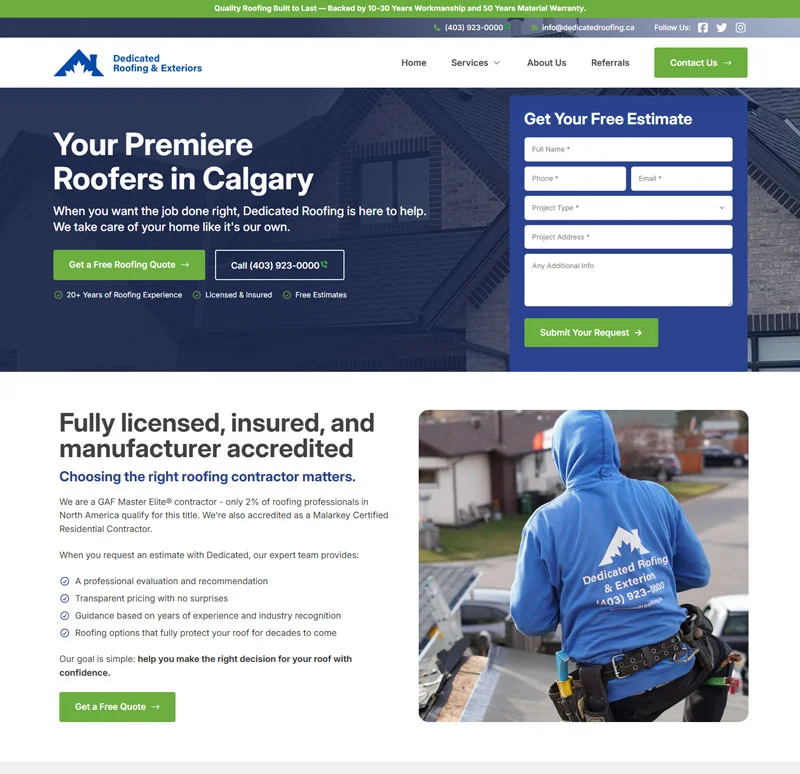
Dedicated Roofing website screenshot

Most roofing websites lose the lead before the estimate form ever gets a chance

The leak usually starts earlier: the headline is generic, the page does not confirm the exact roofing problem quickly enough, and the trust signals show up too late. Google’s people-first content guidance asks whether a page clearly demonstrates first-hand expertise and leaves the reader feeling they learned enough to achieve their goal. 1

For roofing companies, that means the opening section should immediately answer the question behind the search. Is this about storm damage, leak repair, full replacement, soffit and fascia, or siding? If the visitor cannot tell within a few seconds, they start evaluating the next contractor.

Match the page to the roofing job, not just the industry

Google Ads says ad quality reflects the experience users have when they see your search ads and once they reach your landing page, and its Quality Score diagnostics look at factors like ad relevance and landing page experience. 2 Google also says effective landing pages are key to getting conversions from Google Ads traffic. 3

That does not mean a separate page guarantees rankings or lower costs by itself. It does mean a repair search usually deserves a repair page, and a replacement search usually deserves a replacement page. The tighter the match between the visitor’s problem and the page they hit, the less explanation they have to do in their own head.

In our experience, roofing websites get better results when the page structure mirrors real buying intent:

  • urgent leak or storm-damage pages that help someone act fast
  • inspection and estimate pages that reduce uncertainty
  • replacement pages that support a bigger, more considered decision

Show trust before you ask for the estimate request

BrightLocal’s 2026 Local Consumer Review Survey found that 97% of consumers read reviews for local businesses, 85% are more likely to use a business after reading positive reviews, and 54% go on to visit the business’s website after reading positive reviews. 4 Google Business Profile guidance also says businesses with complete and accurate information are more likely to show up in local search results, that replying to reviews shows you value customer feedback, and that photos and videos help tell the story of the business. 5

For roofing websites, that is a strong argument for moving proof earlier in the page:

  • review snippets
  • manufacturer or certification badges when relevant
  • storm, replacement, and repair project examples
  • service-area specificity
  • warranty or workmanship language that reduces risk

An estimate form is not persuasive on its own. It works better when it appears after the visitor has seen enough evidence to believe the company is real, local, and competent.

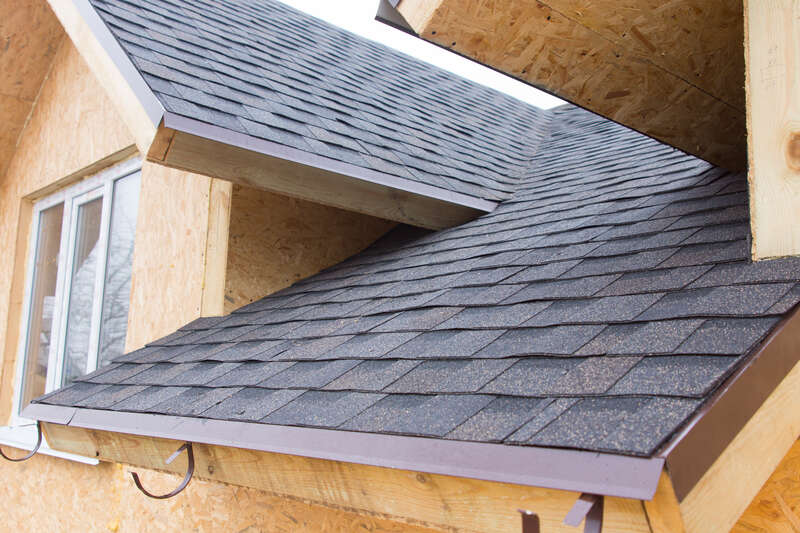
Close-up photo of a newly shingled roof

Keep the estimate path short and easy to scan

Baymard’s 2024 checkout research found that the average checkout flow contains 11.3 form fields and that 18% of users have abandoned because checkout felt too long or complex. 6 Baymard also found that extensive multicolumn forms can lead to misreading and input errors, while single-column layouts are easier to complete and review. 7

Roofing estimate forms are not ecommerce checkouts, but the friction principle still translates well. If the first step looks longer than it needs to, people hesitate.

We usually recommend asking only for what helps start the sales conversation:

  • name
  • phone or email
  • address or postal code
  • service type
  • a short description of the problem

Everything else should justify its existence. If a question is only useful after the callback, let the callback do that work.

Person reviewing a website on a laptop

Mobile roofing leads are impatient leads

Google Ads says one of the easiest ways to improve mobile ad results is to improve landing-page speed, and notes that in retail a one-second mobile delay can impact mobile conversions by up to 20%. 3 web.dev’s performance guidance makes the broader point: websites that load quickly and respond quickly engage and retain users better, while slow sites hurt conversions and business outcomes. 8

Roofing shoppers are often standing in a driveway, in a kitchen after a leak, or comparing companies between other tasks. If the page is slow, the phone number is hard to find, or the first CTA is buried, the visitor does not need much encouragement to leave.

This is why we care so much about clear tap targets, fast pages, and repeated CTAs. The page should feel easier to use than the alternatives, not merely better designed.

A good roofing page answers three things in order

The strongest roofing pages usually answer the same three questions quickly:

  • Is this the right company for my roof problem?
  • Do they actually work in my area and look credible?
  • What is the easiest next step?

When those answers appear in the right order, the estimate form stops feeling like a leap. It feels like the obvious next move.

Sources

  1. Google Search Central: Creating helpful, reliable, people-first content

  2. Google Ads Help: About ad quality

  3. Google Ads Help: Evaluate the performance of your landing pages

  4. BrightLocal: Local Consumer Review Survey 2026

  5. Google Business Profile Help: Tips to improve your local ranking on Google

  6. Baymard: Checkout Optimization - 5 Ways to Minimize Form Fields in Checkout

  7. Baymard: Form Field Usability - Avoid Extensive Multicolumn Layouts

  8. web.dev: Why does speed matter?

Call now Get a free quote